

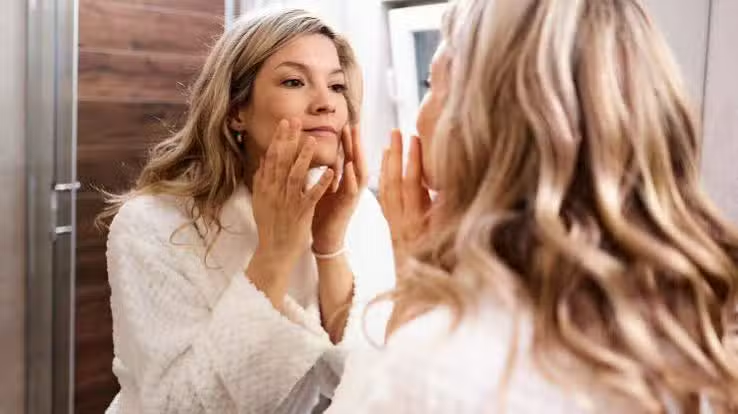
For years, your routine worked. Then, without warning, it didn’t. Breakouts showed up in places they never had before.
What’s actually happening during perimenopause
A widely cited review found that skin can lose up to 30% of its collagen in the first five years surrounding menopause, followed by a slower decline of roughly 2% per year after that.
For years, your routine worked. Then, without warning, it didn’t. Breakouts showed up in places they never had before. Dryness set in where your skin used to stay balanced. Products that once felt gentle suddenly left you red and reactive.
This is one of the most common experiences women describe during perimenopause inside Kelly’s treatment room, and it’s one of the least explained in the skincare industry.
What’s Actually Happening During Perimenopause
Perimenopause skin changes aren’t random. During this transition, estrogen doesn’t decline in a steady line. It fluctuates, sometimes within the same week. Because estrogen signals your skin’s fibroblasts to produce collagen, that fluctuation shows up as inconsistency: a good week, then a bad one, with no clear pattern to point to.
Research backs up what so many women feel in real time. A widely cited review found that skin can lose up to 30% of its collagen in the first five years surrounding menopause, followed by a slower decline of roughly 2% per year after that. In other words, the shift isn’t gradual and mild. It’s often front-loaded and steep, which is exactly why it can feel sudden rather than slow.
Why “Just Use More Product” Doesn’t Work
Most skincare is built for stable skin. Meaning, skin with a predictable baseline that responds the same way most of the time. Perimenopausal skin isn’t stable. It’s adaptive tissue responding to a shifting internal environment. So when a product stops working, the instinct is often to add more of it, switch to something else, or sometimes to something stronger. Instead, that usually backfires, because the skin isn’t undertreated. It’s actually being asked to tolerate more than it currently can.
As Kelly Tracy-Holly, Advanced Aesthetician and Co-Founder of Results by Nature®, puts it: your skin isn’t failing. It’s responding.
Perimenopause Is One Chapter, Not the Whole Story
While perimenopause is one of the clearest examples of hormone-driven skin change, it isn’t the only one. Post-partum shifts, stress-driven hormone changes, and contraception adjustments can all trigger the same underlying pattern: skin that behaved predictably suddenly stops. That’s why Results by Nature® formulates around changing skin as a category, not around a single life stage, because the underlying question is always the same. What is your skin currently adapting to, and does your routine account for that?
What Helps Instead
Rather than adding more actives, skin in hormonal transition generally responds better to formulas that support barrier function and reduce the burden on already-taxed skin. That’s the thinking behind Regenerate and Quench, formulated to work with skin that’s adapting, not against it.
If your routine has quietly stopped working and you haven’t been able to explain why, perimenopause may be part of the answer. Explore hormone-conscious skincare built for exactly this kind of transition.
By Samantha Marut | Results by Nature® | June 2026
© 2026 Results by Nature®. All rights reserved. Skin as a System and Context-Intelligent Aesthetics is a proprietary methodology of Results by Nature®.




Leave A Comment