

By Samantha Marut & Kelly Tracy-Holly | Results by Nature® | April 2026
Skin barrier repair is one of the most misunderstood concepts in skincare and one of the most searched. Most people start with the wrong question.
So imagine this: she hadn’t changed anything.
She uses the same cleanser, the same serum, and the same moisturizer and oil. The routine that had worked beautifully for over a year was suddenly working against her.
Her skin felt oily and dry in a way that moisturizer couldn’t relieve. She was reactive to things that had never bothered her before. She tried layering more. Simplifying. Switching one product at a time.
Nothing changed or improved.
She wanted to know what she was doing wrong.
Nothing.
Her skin had shifted into a different context, and nothing in her routine had kept pace.
This is one of the most common things we see, and one of the least explained. A routine that worked stops working. Not because something was wrong with the products. Because the skin underneath them changed.
Here’s what that actually means.
What the Skin Barrier Actually Does
The answer almost always comes back to the relationship between linoleic acid and the skin barrier and what happens when it breaks down. The skin barrier is not a surface layer. It is a living, active system that regulates moisture retention, inflammation response, and immune signaling. It keeps environmental stressors out and holds in what the body needs to maintain skin function.
To do this, it runs on specific raw materials: lipids, proteins, and fatty acids. When those materials are present in the right balance, the skin barrier repairs itself. Products absorb, moisture holds, and the skin responds predictably. When that balance shifts, the barrier stops performing. Not dramatically. Just quietly, progressively, until one day the routine that used to work no longer works.
Most skincare education focuses on what to apply to the skin. Very little of it explains what the skin is running on underneath, and what happens when that changes.
How Fatty Acids Drive Skin Barrier Repair
Fatty acids are the structural building blocks of the skin barrier. They are not a cosmetic addition. They are part of the barrier’s architecture. They determine how the barrier self-regulates, how it responds to inflammation, how it recovers from disruption, and whether it can receive and use what you apply to it.
There are several distinct fatty acid families relevant to barrier function. Each does a different job. Understanding the difference and how they interact is the clinical layer most skincare skips entirely.
01 — Linoleic Acid (Omega-6): Barrier Repair and Sebum Regulation
Linoleic acid is what the skin barrier uses structurally. It is a key precursor to ceramides, the lipids that form the barrier’s protective matrix. When linoleic acid is present in adequate amounts, the barrier can self-regulate. It holds moisture, manages inflammation, and responds to products the way it should.
Linoleic deficiency is clinically associated with acne-prone skin, barrier dysfunction, chronic inflammation, and transepidermal water loss. When linoleic acid is depleted by hormonal load, inflammatory accumulation, or over-treatment, reactive skin stabilizes poorly, congested skin doesn’t resolve, and post-procedure skin recovers more slowly.
Linoleic acid doesn’t coat the surface. It absorbs because the barrier is asking for it. The skin recognizes it as a raw material it needs.
In Results by Nature® formulations: Kalahari Melon Seed Oil, Red Raspberry Seed Oil, Pumpkin Seed Oil.
02 — Oleic Acid (Omega-9): Penetration Support and Skin Pliability
Oleic acid is emollient and conditioning. It improves skin pliability, supports transdermal delivery of actives, and provides a softer texture in formulation. It has genuine clinical value. It is not the problem.
Excess oleic acid is the problem. Oleic acid alone is not.
Oleic-dominant formulas, those built primarily around argan, marula, olive, or similar oils, are the most common category in mainstream skincare. They work well for skin in a stable state. But for skin that is reactive, hormonally shifting, or barrier-compromised, a formula that is predominantly oleic without adequate linoleic balance can feel like it’s working on the surface without addressing the depletion underneath.
Results by Nature® formulations use oleic acid strategically, in balanced amounts rather than in dominant amounts, deliberately paired with high linoleic content to support penetration without barrier disruption.
In Results by Nature® formulations: Baobab Oil, Ximenia Oil, Pumpkin Seed Oil (in balance).
03 — Alpha-Linolenic Acid (Omega-3): Anti-Inflammatory Signaling
Alpha-linolenic acid down-regulates inflammatory pathways at the skin level. It supports immune-reactive skin conditions, reduces redness, improves tolerance in eczema- and psoriasis-prone presentations, and aids post-treatment calm.
This is immunologic intelligence, not cosmetic soothing. When skin is carrying systemic inflammatory load, topical support for those pathways matters. Omega-3 at the barrier level is part of how the skin manages that load.
In Results by Nature® formulations: Red Raspberry Seed Oil.
04 — Punicic Acid (Omega-5): Tissue Regeneration and Cellular Renewal
Punicic acid is rare. It is found in meaningful concentration in Pomegranate Seed Oil and very few other sources. It has strong antioxidant and anti-inflammatory activity, supports keratinocyte regeneration, and influences collagen architecture.
Clinically, this is most relevant for mature skin, oncology-recovery skin, and barriers thinned by over-treatment or chronic inflammation. It is one of the quiet differentiators in the Results by Nature® formulation approach, present because of what skin in these states actually needs, not because it trends.
In Results by Nature® formulations: Pomegranate Seed Oil.
05 — Ximenynic Acid: Microcirculation and Oxygenation
Ximenynic acid is an advanced lipid science. Derived from Ximenia Seed Oil, it enhances microcirculation and improves oxygen delivery to skin tissue. This supports sluggish, compromised skin at the level of its environment, not just its surface.
Skin barrier repair fails without circulation. The skin cannot recover if nutrient delivery to the tissue is compromised. This fatty acid addresses the environment skin heals, not just the barrier itself.
In Results by Nature® formulations: Ximenia Seed Oil.
06 — Saturated Fatty Acids (Palmitic and Stearic): Structural Support and Moisture Retention
Palmitic and stearic acids reinforce the lipid bilayers that give the barrier its structural integrity. They reduce moisture loss and improve barrier resilience without occlusion, which is why the Results by Nature® oils seal without suffocating.
In Results by Nature® formulations: Baobab Oil, Pumpkin Seed Oil, Kalahari Melon Seed Oil.
When the Balance Shifts and Why
Fatty acid depletion doesn’t arrive dramatically. It happens gradually, driven by changes in the body’s internal environment. There are three primary drivers.
Hormonal Load
Estrogen supports the skin’s ability to produce and maintain barrier lipids, including ceramides that incorporate linoleic acid. When estrogen levels shift during perimenopause, post-partum recovery, hormonal contraception changes, or periods of elevated cortisol, the barrier’s lipid production can be disrupted. Linoleic depletion is often one of the first measurable effects.
Inflammatory Accumulation
Chronic low-grade inflammation from diet, environmental stress, compromised gut health, or repeated barrier disruption affects the skin’s ability to maintain its fatty acid balance. Inflammation consumes linoleic acid as part of the inflammatory response, creating depletion over time even when the skin doesn’t show obvious surface irritation.
Treatment Accumulation
Aggressive or repeated active treatments, including over-exfoliation, strong retinoid protocols, and chemical peels applied without adequate integration periods, can directly disrupt the barrier’s lipid architecture. Each disruption requires recovery. When treatments accumulate faster than the barrier can regenerate, the fatty acid reserve is depleted.
What all three have in common: they change the internal environment of the skin without necessarily announcing it on the surface.
Signs Your Skin Barrier Repair Has Stalled
These are not signs that the products are wrong. They are signs that the skin’s capacity to receive them has changed.
- Moisturizer sits on top of the skin instead of absorbing
- Skin feels both dry and reactive at the same time
- Products that worked for months or years suddenly feel like too much
- New reactivity to ingredients that were previously tolerated
- Skin looks flat or dull, not inflamed, just unresponsive
- Routine hasn’t changed, but outcomes have
The Question Most Skincare Skips
Most skincare education teaches the WHAT: which ingredients work and what they do. Some goes deeper into the WHY: the mechanisms behind ingredient action.
What rarely gets addressed is the WHEN. What can this skin receive right now, given what it’s currently carrying?
“When skin is hormonally shifting or systemically stressed, fatty acid composition matters more than active concentration.”
The same ingredient, with the same intention, can create a different outcome depending on the skin’s current state. Linoleic acid absorbs when the barrier needs it. A formula over-weighted in oleic sits on the surface when the barrier is already depleted. A retinoid advances results when the barrier is stable and triggers reactivity when it isn’t.
The ingredient isn’t always the variable. The skin’s capacity to receive it is.
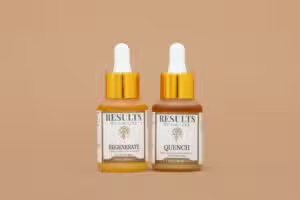
How Regenerate and Quench Were Built
Results by Nature® formulations are not built around single hero oils, cosmetic emollience, or trends. They are built around fatty acid signaling, barrier architecture, and microcirculatory support.
Both Regenerate and Quench are:
- Linoleic-dominant, with the primary fatty acid architecture targeting barrier-level absorption rather than surface conditioning
- Balanced in oleic, present strategically to support penetration and pliability rather than used as the dominant acid
- Inclusive of rare fatty acids, with Omega-5 (punicic) and ximenynic acid included for regeneration and microcirculation support
- Anti-inflammatory by architecture, with Omega-3 (alpha-linolenic) content supporting immune-reactive skin states
- Barrier-first, with actives selected and dosed for compatibility with reactive and depleted skin
- Hormone-conscious, formulated without endocrine-disrupting compounds, because if hormonal load is driving depletion, the skincare should not add to it
- Microdosed, with effective concentrations and without inflammatory burden
They were not built for a skin type. They were built for a skin moment: the moment when what used to work stops working, and the question becomes what the barrier is actually running on and what it needs to restore its own regulation.
If your skin has been flat, reactive, or unresponsive to a routine you haven’t changed, skin barrier repair is not about switching products. This is where to start.
The Takeaway
“Our formulations are built on fatty acid signaling, not trends, because barrier function, inflammation, and recovery are lipid-driven processes.”
When a routine stops working, the instinct is to question the products, to look for something new, something stronger, something that will finally fix it.
But if the skin’s internal environment has shifted, if hormones changed, inflammation accumulated, or treatments overwhelmed the barrier’s recovery capacity, the question isn’t which product to switch to. It’s what the barrier is actually running on and what it needs to restore its own self-regulation.
That distinction changes everything about where to start. And skin barrier repair begins with understanding what your barrier is actually running on.
If you want to understand what your skin is doing right now and why, our free guide breaks it down in plain language. Comment DRIVER on any Instagram post or visit this link.
© 2026 Results by Nature®. All rights reserved. Context-Intelligent Aesthetics is a proprietary methodology of Results by Nature®.





Leave A Comment